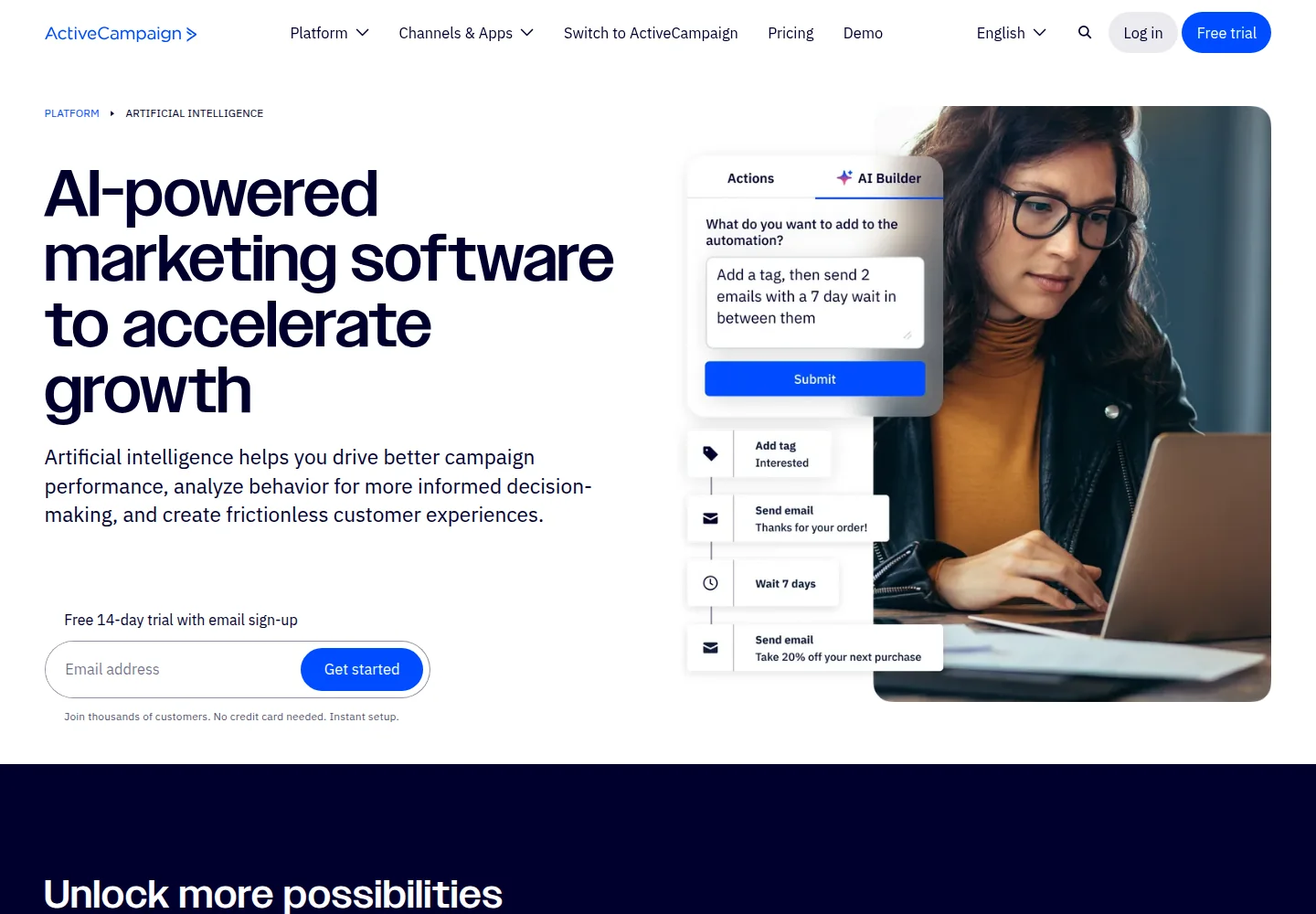
AI-powered marketing software to accelerate growth, inside the ActiveCampaign automation platform.
At a glance
Trial available · Source review 2026-10-20
Price & billing
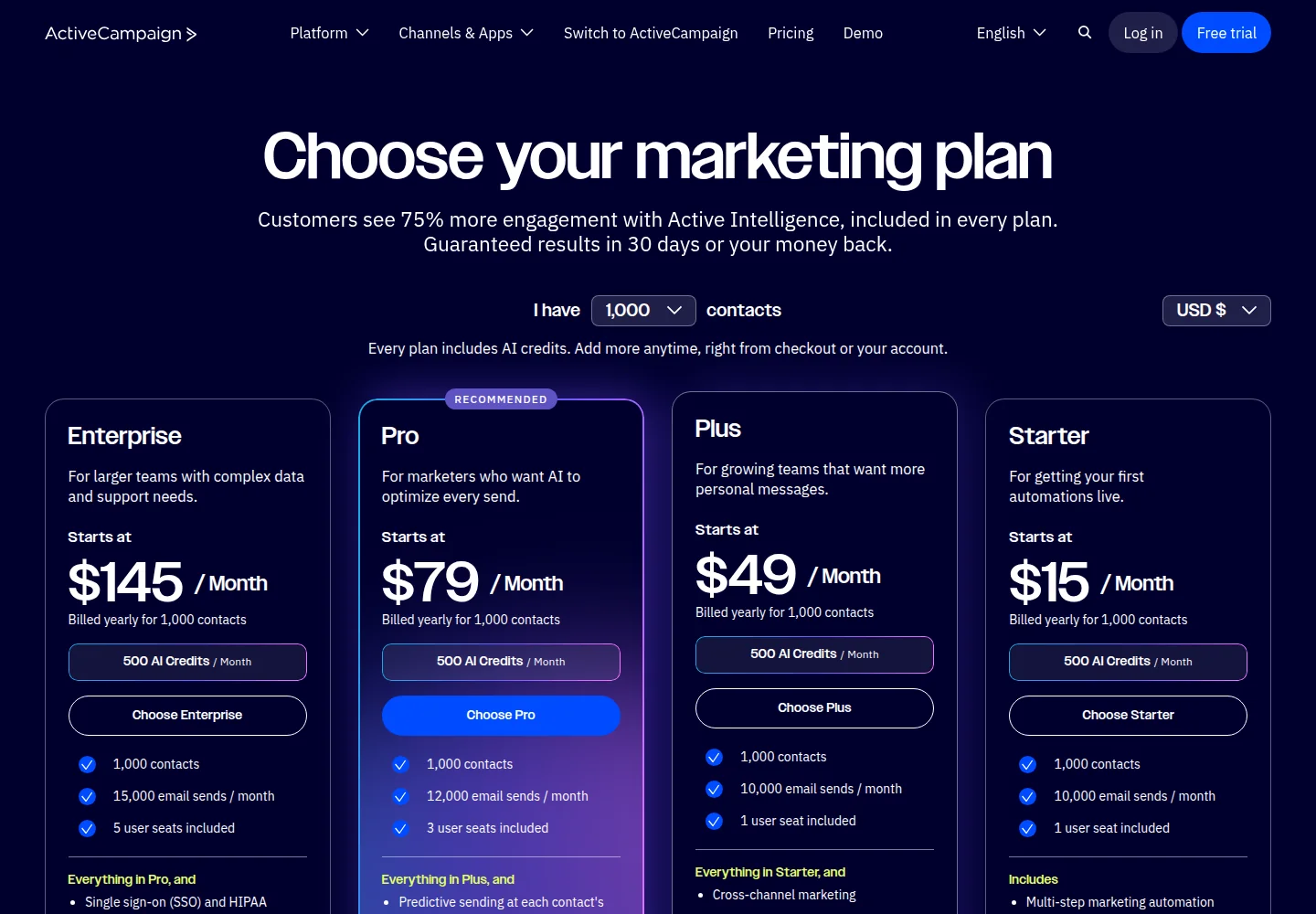
For 1,000 contacts billed yearly: Starter starts at $15 per month, Plus at $49 per month, Pro at $79 per month, and Enterprise at $145 per month. Every plan includes 500 AI Credits per month. A free 14-day trial is offered with email sign-up and no credit card needed.
Small and mid-size marketing teams that want AI help building automations, writing campaigns, segmenting audiences, and sending each email at the right time.
Fit is editorial guidance, not a measured result.
Platforms
Access: not separately verified. Operating systems not separately verified.
Small and mid-size marketing teams that want AI help building automations, writing campaigns, segmenting audiences, and sending each email at the right time.
Limits and trade-offs
Published prices are for 1,000 contacts billed yearly, so cost rises with list size. Every plan includes 500 AI Credits per month on the reviewed pricing page, generative AI content features are not included on Starter, and predictive sending starts on Pro.
Plans and free allowances
For 1,000 contacts billed yearly: Starter starts at $15 per month, Plus at $49 per month, Pro at $79 per month, and Enterprise at $145 per month. Every plan includes 500 AI Credits per month. A free 14-day trial is offered with email sign-up and no credit card needed.
Official-site collection and source-backed editorial review
Dates: Last reviewed 2026-10-21 · Sources checked 2026-10-20. Last reviewed is the latest source or editorial review date; it is not a content-change date.
A closer look at ActiveCampaign AI
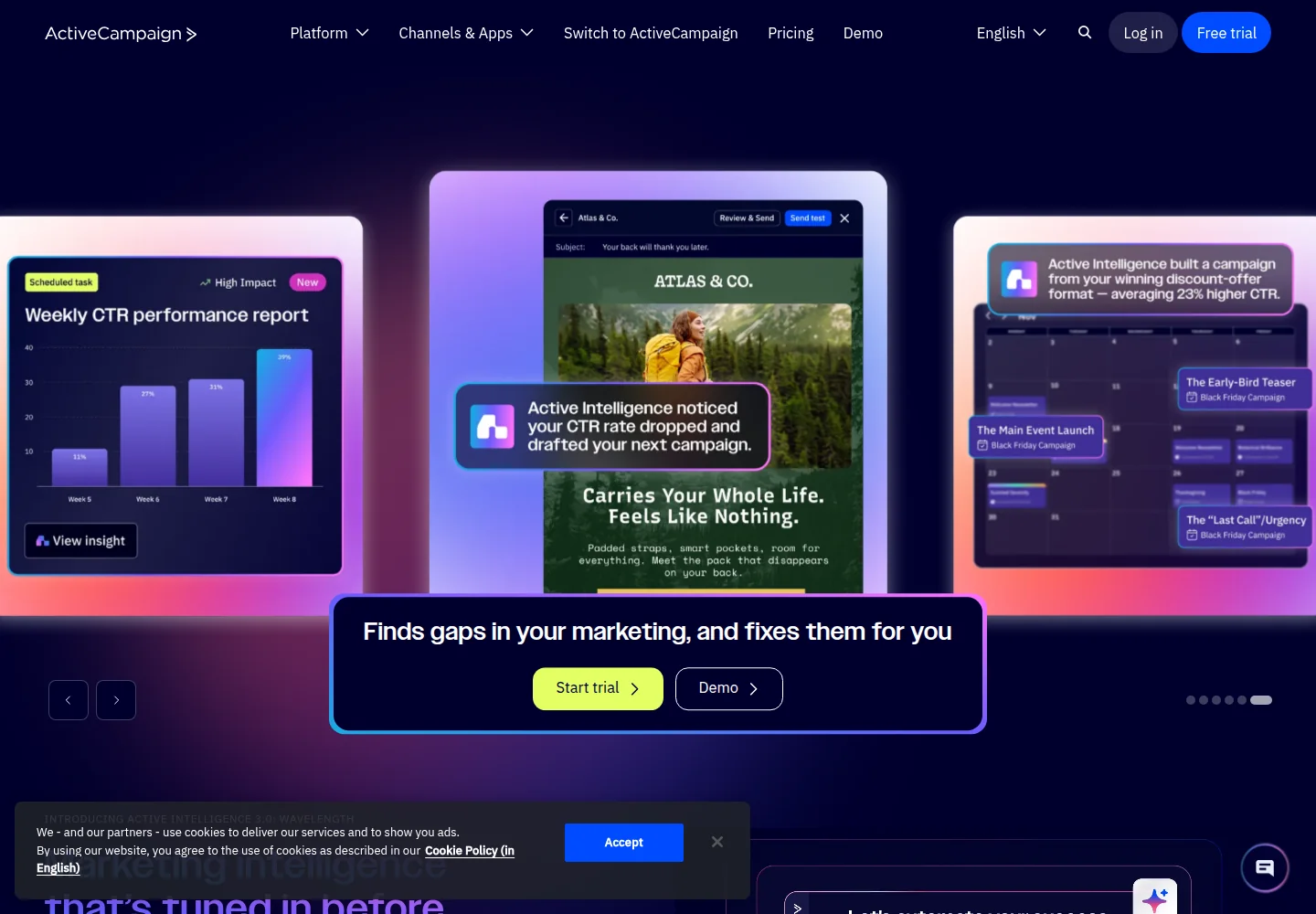
ActiveCampaign AI is the intelligence layer of the ActiveCampaign marketing automation platform. It builds automations from a stated goal, generates campaign content and images, suggests segments, predicts deal win probability, and sends emails when each contact is most likely to open them. Plans bundle 500 AI Credits per month and scale by contact count, with email, SMS, and WhatsApp channels on the platform.
Editorial guidance based on published documentation. The workflow below is a suggested starting point, not a measured product result.
When to choose ActiveCampaign AI
Small marketing teams that want automations built for them from a plain-language goal
Businesses combining email, SMS, and WhatsApp campaigns with CRM and ecommerce data
Senders who want predictive sending and a reporting co-pilot instead of manual A/B timing tests
When to choose something else
Teams that only need a simple free newsletter tool for a small list
Organizations that need SSO or HIPAA support without moving to the Enterprise plan
A practical starting workflow
Start the free 14-day trial and connect your contacts, CRM, or ecommerce store
Describe the outcome you want and let the AI automation builder draft the workflow
On Plus or above, generate campaign copy and images and use the segmentation features included in your plan.
On Pro or above, use predictive sending; review the reporting features available on your selected plan.
Check before committing
Headline prices assume 1,000 contacts billed yearly; larger lists cost more and monthly billing terms differ
AI usage is metered: the reviewed plans include 500 AI Credits per month, with more available to add
Feature gates matter: generative AI is not included on Starter, and predictive sending and conditional content start on higher plans
This entry reviews official published material; no authenticated hands-on product test was performed.
Common questions
How much does ActiveCampaign cost?
For 1,000 contacts billed yearly, Starter starts at $15 per month, Plus at $49 per month, Pro at $79 per month, and Enterprise at $145 per month, each including 500 AI Credits per month.
The AI page lists an AI-powered automation builder, generative AI writing tools, win probability prediction, predictive sending, an AI brand kit, and AI-suggested segments.
HubSpot — Companies standardizing on HubSpot's CRM that need marketing automation, lead scoring, and attribution living in the same database as sales and service — especially teams that will actually use Profes
Zapier — Teams that want no-code automation across 9,000+ apps, with Zap workflows, Tables, Forms, Canvas and Agents.; RevOps, marketing, IT, HR, sales and customer support teams that want to automate work across their stack.
ActiveCampaign's AI features sit within its marketing automation platform for businesses managing campaigns and customer engagement. Published capabilities include generating campaign content, building automations from goals, predictive email timing, and audience insights. Feature access varies by plan: the Starter tier limits each automation to five actions, and some AI activities are add-ons. A separate solutions page advertises a 14-day trial without a credit card.
Capabilities and conditions
Builds marketing automations from a user's stated objective. Source ↗
Predictive Sending selects email timing using contacts' preferences and behavior. Source ↗
The solutions page offers a 14-day trial without requiring a credit card. Source ↗
The Starter plan allows five actions per automation. Source ↗
AI translations are listed under the additional AI Activities add-on. Source ↗
Price and free allowance
See the sourced plan statements above; confirm currency, billing period and checkout eligibility on the vendor site.
Published-source profile · collected 2026-10-17. Automated collection followed by editorial review. These are vendor-published claims, not hands-on product test results.
Alternatives to ActiveCampaign AI
Tools the catalogue itself links to ActiveCampaign AI: an editor lists them as related, an editorial comparison or switching guide covers the pair, or both are reviewed picks for the same task. Each reason below can be checked on the tool pages. This is not a quality ranking.
Why it is listed Same category: Marketing & SEO · Covered in an editorial comparison with ActiveCampaign AI · Listed by editors as related to ActiveCampaign AI
When this listing’s recorded facts changed, from what to what. Dates are the day (UTC) the change was recorded in the ByTask data, not the day the vendor changed anything. Only changes that can be traced in the data history appear here; a fact that has not changed shows nothing.


 Official site reference


