Macswarm provides serverless cloud macOS Pods on Apple silicon for AI coding agents such as Claude Code and Codex, each Pod shipping with the latest Xcode and booted iOS Simulators. A Pod belongs to one developer, is destroyed ten minutes after the last session, and is billed per Pod-hour; paid plans add included monthly Pod-hours.
Fit is editorial guidance, not a measured result.
Platforms
Access: not separately verified. Operating systems not separately verified.
Published-source facts and editorial guidance. No product test is implied. Confirm current conditions before purchase.
Official website; English-locale capture · Captured 2026-11-29 · Source ↗
This listing has 1 image; no further gallery images exist.
What to know before choosing
Good fit
Macswarm provides serverless cloud macOS Pods on Apple silicon for AI coding agents such as Claude Code and Codex, each Pod shipping with the latest Xcode and booted iOS Simulators. A Pod belongs to one developer, is destroyed ten minutes after the last session, and is billed per Pod-hour; paid plans add included monthly Pod-hours.
Limits and trade-offs
Users must bring their own Claude or OpenAI subscription; Macswarm supplies only the Macs.
Plans and free allowances
Pro includes 300 Pod-hours for $99 a month. The Free plan includes 3 Pod-hours once.
Maker-submitted product description
Reviewed for publication 2026-11-20. This material was supplied with the submission; it is not a hands-on test or independent verification of every claim.
The official site offers a free trial or a one-time free allowance and no recurring free plan, so the pricing model the maker reported is not shown here. Check the official site for current terms.
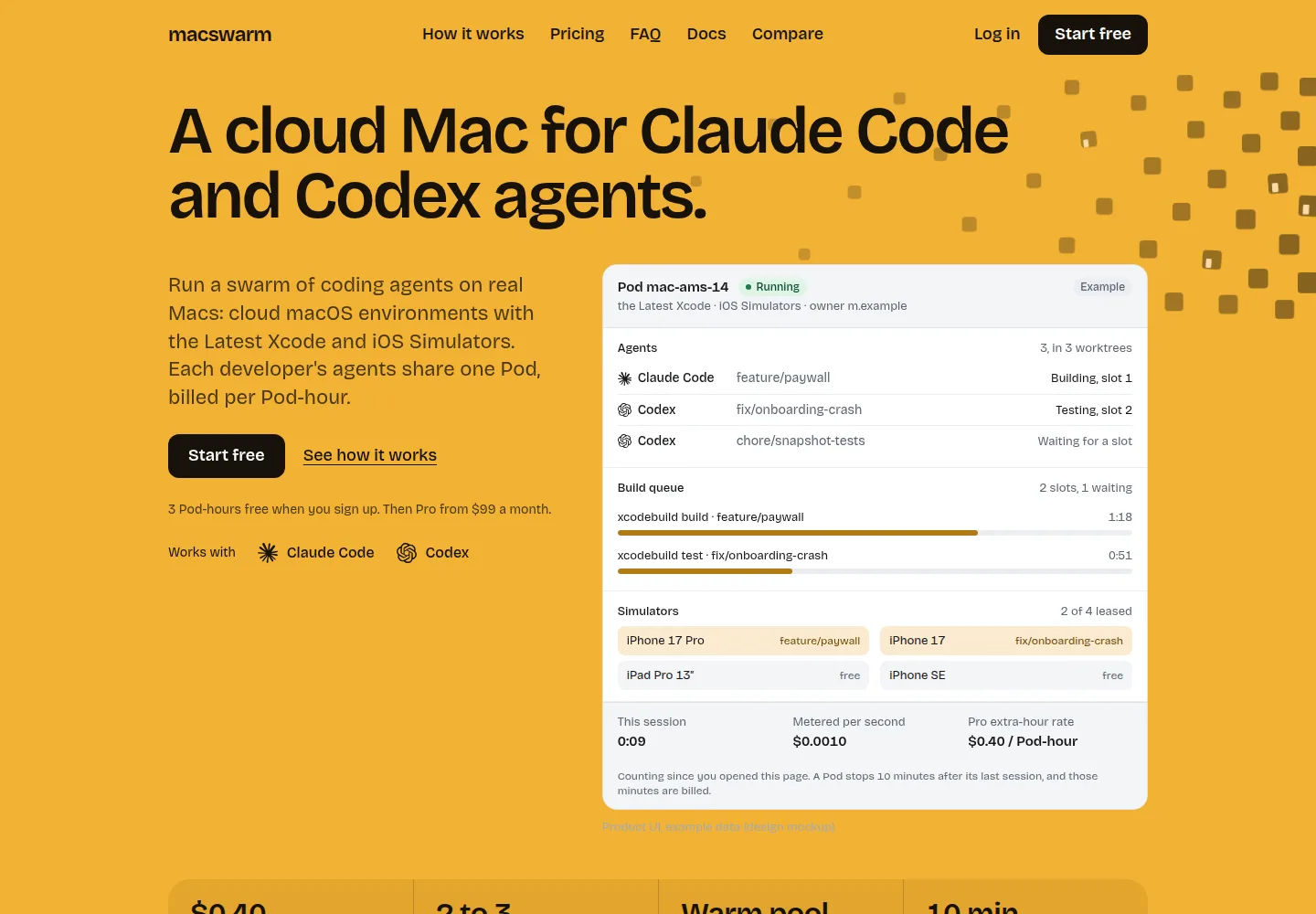
Macswarm runs macOS virtual machines (Pods) on Apple silicon and exposes them to coding agents. Claude Code attaches through Anthropic's self-hosted environments; Codex through the OpenAI Agents API webhook. A Pod ships with the Latest Xcode, iOS runtimes, pre-booted Simulators, XcodeBuildMCP and a two-slot build queue, so an agent can run xcodebuild, boot a Simulator and read test results on a machine it does not have locally. Billing is per Pod-hour, metered per second; idle Pods stop. Each Pod is cloned from a golden image and destroyed after the session, with outbound-only networking. Regions: EU (Netherlands) and US. The free start is 3 Pod-hours, one time, no card needed.
Official-site collection and source-backed editorial review
Dates: Last reviewed 2026-11-28 · Sources checked 2026-11-26 · Catalogued 2026-11-20. Last reviewed is the latest source or editorial review date; it is not a content-change date.
A closer look at Macswarm
Macswarm is cloud macOS built for AI coding agents. Each Pod is a macOS virtual machine on Apple silicon, preloaded with the latest Xcode and the iOS Simulators, and it belongs to one developer: that developer's Claude Code and Codex sessions share the same Pod, so the agents work on one machine with one state. Ten minutes after the last session ends, the Pod is destroyed — and those last ten minutes are billed. Billing is per Pod-hour, metered per second, and the Macs run in the EU (Netherlands) or the US. You connect by pasting the environment key from your Claude Team or Enterprise organization, or by pointing an OpenAI Agents API webhook at Macswarm; the agent can then build, run the simulators and open the pull request with screenshots attached. Isolation is structural: every developer gets their own Pod, cloned fresh from a golden image and never reused across customers. Networking is outbound-only — api.anthropic.com, api.openai.com and your git host — with no inbound ports and no SSH. Pricing is packaged in Pod-hours: the free tier gives 3 Pod-hours once, Pro is $99 a month for 300 Pod-hours (about 3 developers, up to 4 Pods at once, $0.40 per extra hour), Team is $399 a month for 1,500 hours (about 15 developers, up to 10 Pods, audit log, $0.30 per extra hour), and Enterprise starts at $3,000 a month for a dedicated Mac pool with SSO/SAML and invoice billing. Macswarm supplies only the Macs — you bring your own Claude or OpenAI subscription.
Editorial guidance based on published documentation. The workflow below is a suggested starting point, not a measured product result.
When to choose Macswarm
Your Claude Code or Codex agents need real macOS with Xcode and iOS Simulators, which Linux sandboxes cannot provide.
A small team wants per-developer isolated Macs that spin up per session and destroy themselves afterwards, billed by the second.
You want agents to work outbound-only, with no inbound ports or SSH to secure.
When to choose something else
You do not have a Claude or OpenAI subscription — Macswarm supplies the Macs only; the model subscription is yours.
You need a persistent Mac that keeps state between sessions: Pods are destroyed 10 minutes after the last session ends.
Your workload is Linux-based: Pods are macOS machines, located in the EU (Netherlands) or the US.
A practical starting workflow
Connect Macswarm with the environment key from your Claude Team or Enterprise organization, or point your OpenAI Agents API webhook at it.
Start a Claude Code or Codex session; a fresh Pod is cloned from the golden image for you.
Let the agents build and test with Xcode and the iOS Simulators, and open the pull request with screenshots attached.
End the session; the Pod is destroyed 10 minutes later and you are billed per Pod-hour, metered per second, for the minutes it ran.
Check before committing
The free tier is a one-time 3 Pod-hours, not a recurring free allowance.
The 10 minutes between the last session ending and the Pod's destruction are billed.
The developer counts attached to the plans ('about 3 developers' on Pro, 'about 15' on Team) are the vendor's own framing.
Common questions
Do I need my own Claude or OpenAI subscription?
Yes. Macswarm supplies the Macs; Anthropic or OpenAI supplies the model. You connect with the environment key from your Claude Team or Enterprise organization, or through an OpenAI Agents API webhook.
The free tier includes 3 Pod-hours once. Pro is $99 a month for 300 Pod-hours, then $0.40 per extra Pod-hour; Team is $399 a month for 1,500 Pod-hours, then $0.30; Enterprise reserves dedicated Macs from $3,000 a month. Billing is per Pod-hour, metered per second.
A Pod is destroyed ten minutes after its last session ends, and those ten minutes are billed. Each Pod is cloned fresh from a golden image for one developer and is never reused across customers.
Macswarm provides serverless cloud macOS Pods on Apple silicon for AI coding agents such as Claude Code and Codex, each Pod shipping with the latest Xcode and booted iOS Simulators. A Pod belongs to one developer, is destroyed ten minutes after the last session, and is billed per Pod-hour; paid plans add included monthly Pod-hours.
Capabilities and conditions
Each Pod is a macOS virtual machine on Apple silicon with the latest Xcode and iOS Simulators. Source ↗
Pro includes 300 Pod-hours for $99 a month. Source ↗
Users must bring their own Claude or OpenAI subscription; Macswarm supplies only the Macs. Source ↗
Pods run on Apple silicon Mac minis in the EU (Netherlands) or the US. Source ↗
Price and free allowance
See the sourced plan statements above; confirm currency, billing period and checkout eligibility on the vendor site.
Published-source profile · collected 2026-11-28. Automated collection followed by editorial review. These are vendor-published claims, not hands-on product test results.
Alternatives to Macswarm
Tools the catalogue itself links to Macswarm: an editor lists them as related, an editorial comparison or switching guide covers the pair, or both are reviewed picks for the same task. Each reason below can be checked on the tool pages. This is not a quality ranking.
When this listing’s recorded facts changed, from what to what. Dates are the day (UTC) the change was recorded in the ByTask data, not the day the vendor changed anything. Only changes that can be traced in the data history appear here; a fact that has not changed shows nothing.


 Official site reference


