VidCrawl is a video context API for AI agents: one API turns public videos from YouTube, TikTok, Instagram Reels and X into timestamped transcripts, storyboard sheets and sharp frames, returned as Markdown and JSON, with an agent endpoint that answers questions about a video with timestamped citations. Access is layered - a keyless playground/MCP with 3 free live runs per day and no account, plus 100 free credits on every new account - and usage is pay-per-call in credits (1 credit per scrape, frames or search; 3-10 for agent questions) from one-time packs that never expire: Starter $9 for 1,000 credits, Growth $29 for 4,000.
Fit is editorial guidance, not a measured result.
Platforms
Access: not separately verified. Operating systems not separately verified.
Published-source facts and editorial guidance. No product test is implied. Confirm current conditions before purchase.
Maker-provided screenshot · Capture date not recorded · Asset reviewed 2026-11-19 · Source ↗Maker-provided screenshot · Capture date not recorded · Asset reviewed 2026-11-19 · Source ↗
This listing has 2 images.
What to know before choosing
Good fit
VidCrawl is a video context API for AI agents: one API turns public videos from YouTube, TikTok, Instagram Reels and X into timestamped transcripts, storyboard sheets and sharp frames, returned as Markdown and JSON, with an agent endpoint that answers questions about a video with timestamped citations. Access is layered - a keyless playground/MCP with 3 free live runs per day and no account, plus 100 free credits on every new account - and usage is pay-per-call in credits (1 credit per scrape, frames or search; 3-10 for agent questions) from one-time packs that never expire: Starter $9 for 1,000 credits, Growth $29 for 4,000.
Limits and trade-offs
100 free credits on every new account, no card required; one-time credit packs never expire.
Plans and free allowances
3 free live runs per day, no account needed; sign up for 100 free credits.
Maker-submitted product description
Reviewed for publication 2026-11-19. This material was supplied with the submission; it is not a hands-on test or independent verification of every claim.
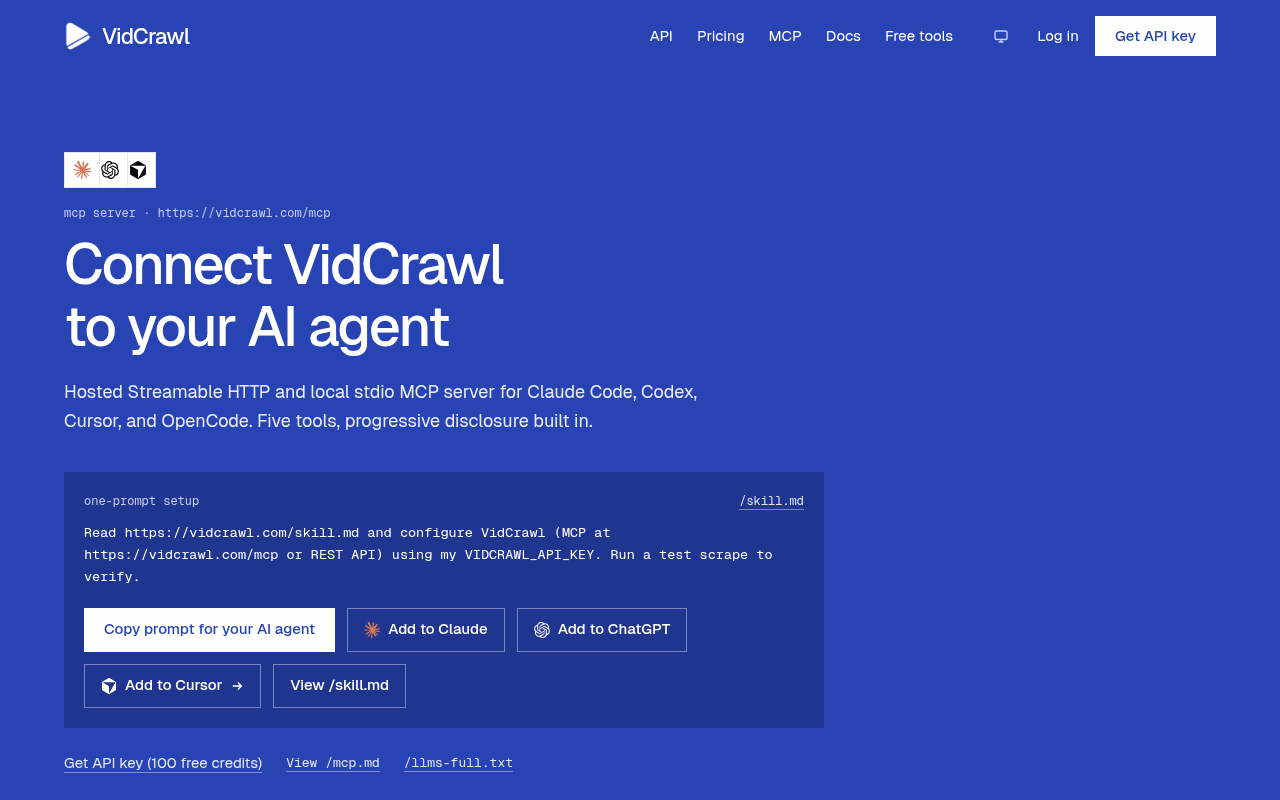
VidCrawl is a model-agnostic video context API and MCP server for AI agents and developer pipelines. Instead of downloading full MP4 files into a multimodal prompt, VidCrawl applies progressive disclosure: one deterministic /v1/scrape call (1 credit, zero LLM tokens) returns metadata, chapters, deduplicated timestamped transcripts, visual storyboard grids, and Markdown across YouTube, TikTok, Instagram Reels, and X. Request sharp frames at exact timestamps via /v1/frames (1 credit) or cited JSON via /v1/agent (3/5/10 credits). Connect via hosted MCP at https://vidcrawl.com/mcp or npx -y @vidcrawl/mcp. Start with 100 free credits or $9 for 1,000 non-expiring credits.
Maker-reported pricing model: freemium. Pricing has not been independently verified. Confirm current plans on the official website.
Official-site collection and source-backed editorial review
Dates: Last reviewed 2026-11-28 · Catalogued 2026-11-19. Last reviewed is the latest source or editorial review date; it is not a content-change date.
A closer look at VidCrawl
VidCrawl is a video context API built for AI agents: it turns public videos from YouTube, TikTok, Instagram Reels and X into timestamped transcripts, storyboards and sharp frames, delivered as Markdown or JSON over one API. Instead of sending a whole video to a multimodal model, an agent works in three layers — it reads the transcript, chapters and metadata as one Markdown document, glances at a storyboard sheet of small frames taken every ten seconds, and zooms into full-resolution frames only at the timestamps that matter. Extraction on the scrape and frames endpoints is deterministic — no model runs, so the same video always returns the same text — and when a video has no captions, speech is transcribed with timestamps as a fallback. A separate agent endpoint reads, glances and zooms on the agent's behalf and answers questions with a timestamped citation behind every claim. There are four endpoints — /v1/scrape, /v1/frames, /v1/search and /v1/agent — reachable by REST or MCP, with an OpenAPI spec and llms.txt so coding agents can discover the API without a custom SDK. Pricing is per call in credits: scrape, frames and search cost 1 credit each, the agent endpoint costs 3, 5 or 10 credits by effort level, and one-time packs (1,000 credits for $9; 4,000 credits for $29) never expire. Failed scrapes refund automatically, and same-account cache hits within 24 hours cost nothing. Anyone can try three free live runs a day with no account, and new accounts start with 100 free credits with no card required — a one-time starter amount, separate from the daily keyless trial runs.
Editorial guidance based on published documentation. The workflow below is a suggested starting point, not a measured product result.
When to choose VidCrawl
You are building an agent or RAG pipeline that needs to quote what was actually said in a video, with timestamps anyone can verify.
You use Claude Code, Cursor or another coding agent and want it to follow a tutorial video, or pull the exact frame where a settings screen or line of code appears.
You monitor topics, brands or launches on YouTube and need the searchable text of what was said, not just titles and thumbnails.
When to choose something else
You need transcripts of private, age-restricted or deleted videos — those return a clear error instead of partial data.
You want a human workspace for editing and exporting transcripts — VidCrawl is an API returning Markdown and JSON for agents, not an editing UI.
Your videos live on platforms beyond YouTube, TikTok, Instagram Reels and X — coverage stops at those four.
A practical starting workflow
Try the playground or keyless MCP (3 free runs per day), or create a free account and copy your API key — new accounts start with 100 credits, no card required.
POST a public video URL to /v1/scrape to get the transcript, chapters, metadata and storyboard as one Markdown document (1 credit).
If a moment needs visual proof, call /v1/frames for sharp frames at exact timestamps; or call /v1/agent with a question and let it read, glance and zoom for you (3, 5 or 10 credits by effort).
Feed the Markdown or JSON into your agent, RAG index or notes pipeline; repeat calls on the same account within 24 hours hit the cache and cost 0 credits.
Check before committing
For long videos without captions, only the first part is transcribed and the response says how much was covered — check the coverage note before quoting.
Only the /v1/agent endpoint calls a model; scrape and frames are deterministic extraction, so question answering is a separate, separately priced step.
Budgeting is strictly per call: every endpoint has a fixed credit price, so costs scale directly with the number of videos and agent questions you run.
Common questions
Which platforms does VidCrawl work with?
Public videos on YouTube (including Shorts), TikTok, Instagram Reels, and X. Private, age-restricted, or deleted videos return a clear error instead of partial data.
VidCrawl transcribes the speech with timestamps as an ASR fallback. For long videos without captions, only the first part is transcribed and the response states how much was covered.
Does VidCrawl use an LLM to produce the transcript?
No. /v1/scrape and /v1/frames are deterministic and return the same text for the same video; only the /v1/agent endpoint calls a model, and you choose when to use it.
The playground reads any public video free with a daily limit (3 free live runs per day, no account needed). A free account comes with 100 credits and no card; after that, one-time packs cost $9 for 1,000 credits or $29 for 4,000, and failed scrapes refund automatically.
TranscriptAPI.com — TranscriptAPI is a YouTube transcript API that also offers video search, channel browsing and playlist extraction via REST API, MCP and agent skills, with one credit per successful request and no YouTube Data API quota used.
VidiRelay — Turning public social videos and uploads into editable, timestamped transcripts with many export formats.
Transcriptik — Transcriptik is an AI transcript generator that turns audio, video and online content into accurate text across 99+ languages, starting from a TikTok, Instagram, YouTube or direct media link or an uploaded file, with timestamps and speaker labels.
VidCrawl is a video context API for AI agents: one API turns public videos from YouTube, TikTok, Instagram Reels and X into timestamped transcripts, storyboard sheets and sharp frames, returned as Markdown and JSON, with an agent endpoint that answers questions about a video with timestamped citations. Access is layered - a keyless playground/MCP with 3 free live runs per day and no account, plus 100 free credits on every new account - and usage is pay-per-call in credits (1 credit per scrape, frames or search; 3-10 for agent questions) from one-time packs that never expire: Starter $9 for 1,000 credits, Growth $29 for 4,000.
Capabilities and conditions
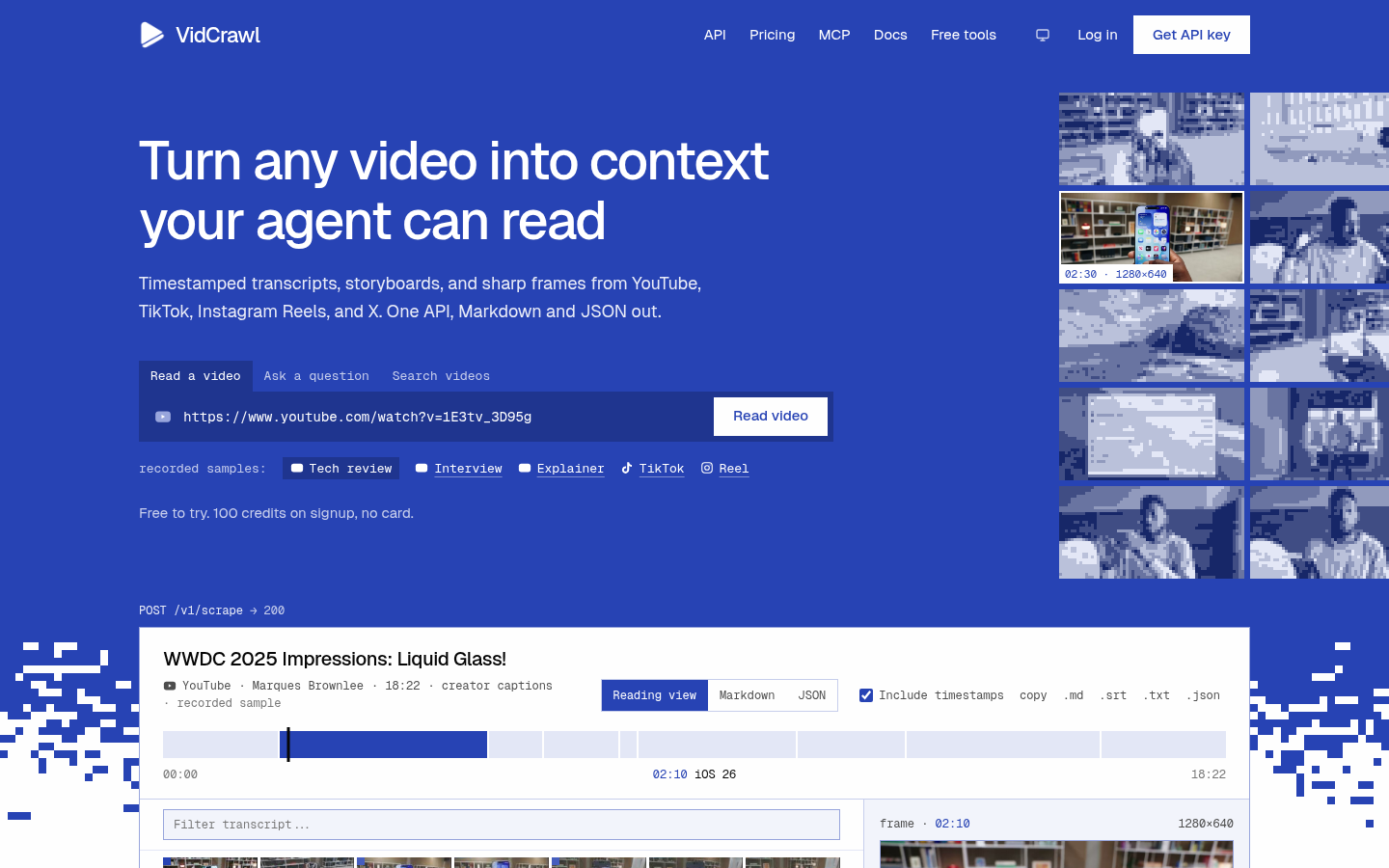
Turn any video into context your agent can read: timestamped transcripts, storyboards, and sharp frames from YouTube, TikTok, Instagram Reels, and X. Source ↗
3 free live runs per day, no account needed; sign up for 100 free credits. Source ↗
100 free credits on every new account, no card required; one-time credit packs never expire. Source ↗
Price and free allowance
See the sourced plan statements above; confirm currency, billing period and checkout eligibility on the vendor site.
Published-source profile · collected 2026-11-28. Automated collection followed by editorial review. These are vendor-published claims, not hands-on product test results.
Alternatives to VidCrawl
Tools the catalogue itself links to VidCrawl: an editor lists them as related, an editorial comparison or switching guide covers the pair, or both are reviewed picks for the same task. Each reason below can be checked on the tool pages. This is not a quality ranking.
When this listing’s recorded facts changed, from what to what. Dates are the day (UTC) the change was recorded in the ByTask data, not the day the vendor changed anything. Only changes that can be traced in the data history appear here; a fact that has not changed shows nothing.


 Official site reference


