Official published documentation reviewed; not a product test
Dates: Last reviewed 2026-11-28 · Sources checked 2026-11-24. Last reviewed is the latest source or editorial review date; it is not a content-change date.
A closer look at Factiverse
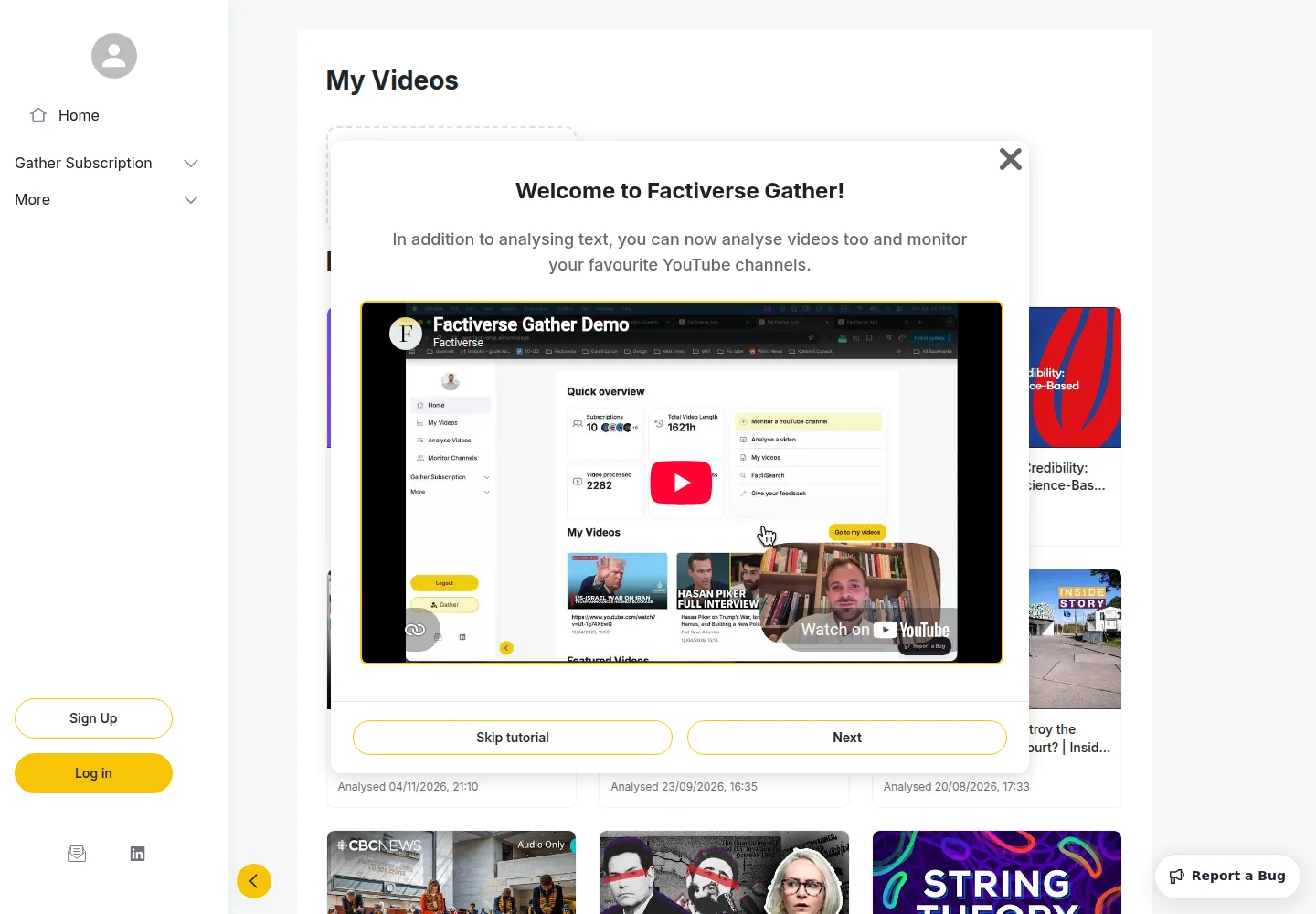
Factiverse is a claim-verification platform for people who publish or rely on factual content. Its machine-learning models read a text, identify the factual statements in it, and return live sources that support or dispute each one, drawing on public and proprietary data. It is designed to sit inside existing workflows rather than replace them: there is an AI Editor, a Factiverse experience inside ChatGPT, and an API that can be integrated into an app, platform or CMS, with shareable reports and team management for collaborative checking. The vendor is candid about the limits of the approach — the model has no inherent knowledge of what is true or false and is an aid to human verification, performing best on news articles and well-covered topics such as COVID-19, climate change and US and EU politics. Claim identification works across more than 100 languages, with the most precise answers in English. A sister product, Gather, applies the same machinery to video and audio research: it monitors preselected or arbitrary YouTube channels, produces transcripts with timestamps, sends email notifications and exposes the processed data through an API. Plans run from a free Lite tier through per-seat Basic and Pro subscriptions to custom Teams and high-volume API arrangements, although the pricing page presents more than one plan family side by side (see caveats).
Editorial guidance based on published documentation. The workflow below is a suggested starting point, not a measured product result.
When to choose Factiverse
A newsroom or publisher that needs claims in drafts flagged and sourced before publication, including inside its CMS via the API.
A communications or content team verifying factual assertions in articles, blog posts and reports as part of its daily workflow.
A researcher or media monitor using Gather to follow YouTube channels with transcripts, timestamps and email alerts instead of watching hours of video.
When to choose something else
Anyone expecting a definitive true/false verdict: the vendor itself says the model does not know what is true and is built to assist human fact-finding, not replace it.
Work far outside well-covered news topics — the vendor says it performs most accurately on news and heavily covered subjects, and its finance and compliance models are still in training.
Teams that need equal precision in languages other than English: claim identification covers 100+ languages, but the vendor says the most precise and factual answers are in English.
A practical starting workflow
Submit text in the AI Editor, through Factiverse in ChatGPT, or via the API from your own app or CMS.
The model identifies the factual statements in the text automatically.
Factiverse searches public and proprietary sources and returns live sources that support or dispute each claim.
Review the findings and share them through shareable reports; manage access with team management.
For video and audio, connect YouTube channels in Gather and receive monitoring, transcripts with timestamps and email notifications.
Check before committing
The pricing page carries two plan presentations side by side with conflicting terms — one lists Lite free with 20 AI credits/month, Basic at €10/month and Pro at €25/month, while another lists Pro at $6.99/month billed annually with different character limits, plus separate workflow/API plans (Grow at $3,000/month). Verify which plan family currently applies before subscribing.
The Lite tier's text limit is printed as 30 characters per request in one listing, against 3,000 characters for Basic in the other — as printed it looks like a page error, so treat the free tier's real limit as unconfirmed.
Testimonials and accuracy anecdotes on the page (for example a transcript accuracy of almost 95% in one editor's account) are customer statements published by the vendor, not independently measured results.
Common questions
How does Factiverse work?
Factiverse uses advanced machine learning to analyze text and identify factual statements. It then provides live sources that either support or dispute those statements. It is trained on articles from reputable news media and certified fact-checkers.
Its AI Editor, GPT and API capabilities can automatically identify claims in over 100 languages, but you get the most precise and factual answers in English.
Can Factiverse be integrated into our own platform?
Yes. Factiverse can be integrated with your app, platform or CMS as an API, and the vendor is currently training models focused on fact-checking in finance and compliance.
Originality.AI — A publisher, agency or school that needs to check submitted text for AI generation and plagiarism; A writer who wants a writing replay to show authorship alongside detection results
IamVERA — Professionals who must act on AI answers for advice, decisions or case files.; Lawyers and advisers who need a second, critical read of AI output.
Liminary — Researchers and analysts who want captured sources verified and synthesized into recall.
Alternatives to Factiverse
Tools the catalogue itself links to Factiverse: an editor lists them as related, an editorial comparison or switching guide covers the pair, or both are reviewed picks for the same task. Each reason below can be checked on the tool pages. This is not a quality ranking.
When this listing’s recorded facts changed, from what to what. Dates are the day (UTC) the change was recorded in the ByTask data, not the day the vendor changed anything. Only changes that can be traced in the data history appear here; a fact that has not changed shows nothing.

 Official site reference


