Consensus
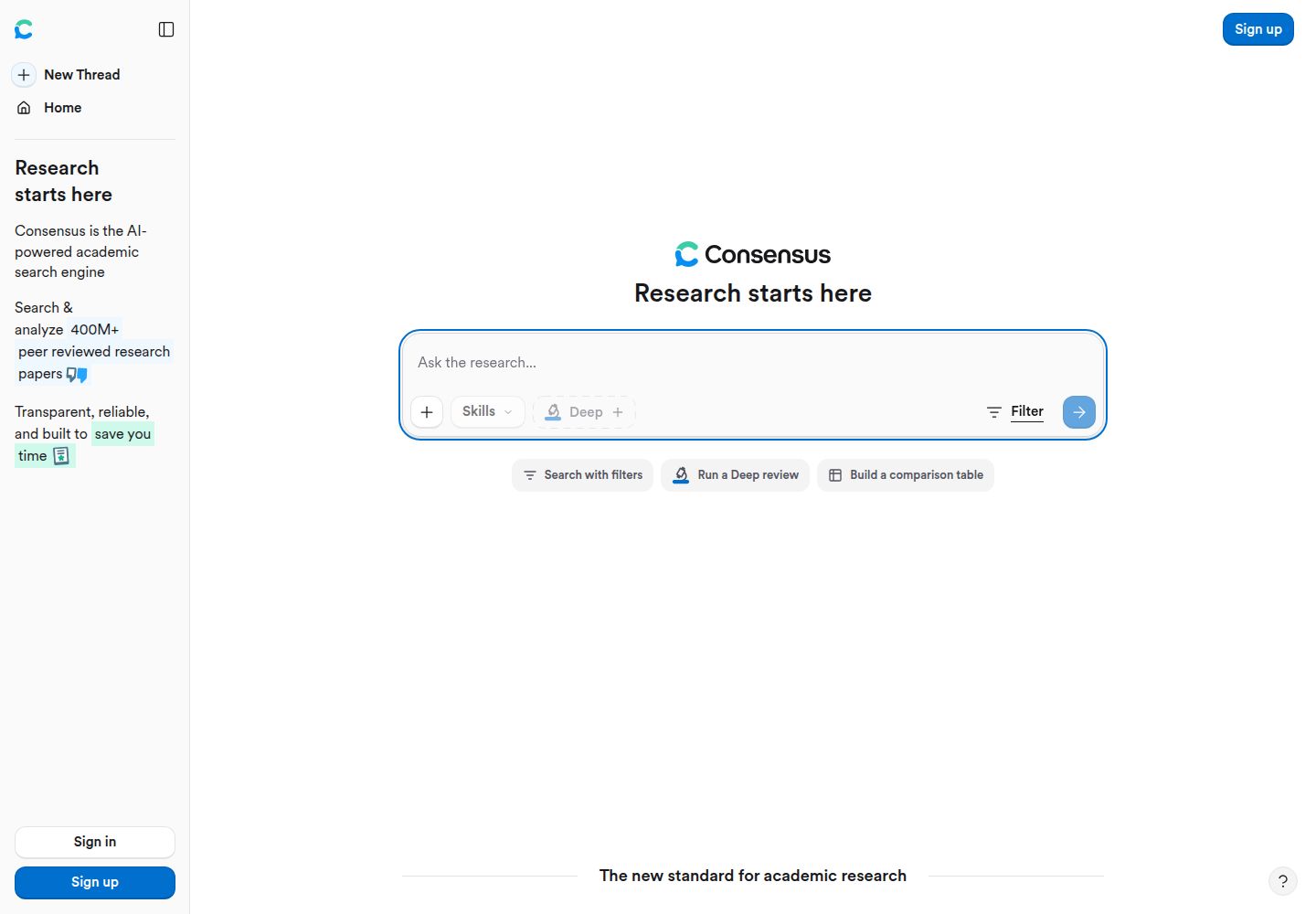
A research search tool that summarizes scholarly papers and links answers to source studies.
What to know before choosing
Good fit
People who need a first-pass map of published research with citations to verify.
Limits and trade-offs
The database is not comprehensive, AI can misread papers, and full-text access depends on the source.
Plans and free allowances
Consensus lists a Free tier. Pro is displayed as $20/month or $144/year billed annually; the page does not explicitly label currency.
Evidence
Official search and citation workflow ↗ (reviewed 2026-10-15), Official plans ↗ (reviewed 2026-10-15), Official AI limitations ↗ (reviewed 2026-10-15), Official database and full-text access ↗ (reviewed 2026-10-15)
Official product, plan, and help pages reviewed; no authenticated product test. Last source review is not a date of product testing.
A closer look at Consensus
Consensus searches scholarly literature and presents paper-linked summaries to help locate studies and compare claims. Treat it as a discovery aid, then inspect source papers for methods, limitations, and context before citing or deciding.
Editorial guidance based on published documentation. The workflow below is a suggested starting point, not a measured product result.
When to choose Consensus
- A student or analyst needs a first-pass search on a focused question.
- A researcher wants cited papers while organizing themes.
- A presenter needs an evidence shortlist for a source-checked deck.
When to choose something else
- A user needs an exhaustive systematic review or proof no study exists.
- A decision depends on full text unavailable from the publisher or an open source.
A practical starting workflow
- Turn the topic into a focused question with a defined population or outcome.
- Search papers and open cited sources rather than relying on summaries alone.
- Record study design, sample, results, and limitations in an evidence table.
- Check whether full text is available and distinguish it from abstract-only evidence.
- Draft claims with citations to verified papers.
Check before committing
- Consensus says its database is not comprehensive and AI can misread source material.
- Some records provide metadata or abstracts rather than full text.
- Pro page displays a dollar sign without specifying currency; confirm checkout.
Common questions
Does Consensus search every academic paper?
No; its database is not comprehensive, so absence from results does not prove no relevant evidence exists.
Official AI limitations ↗ · Official database and full-text access ↗
Can I cite a Consensus answer directly?
Use the linked paper as the source and verify the claim; summaries can misread source material.
Official search and citation workflow ↗ · Official AI limitations ↗
Will I always get full text?
No. Access varies; some records provide metadata or abstracts only.
What is in the Free tier?
The plans article lists paper searches and limited Pro tools; check the plan table for current quotas.
Compare approaches for this task
- Perplexity — Finding source leads for changing topics, then checking the original pages before drafting a comparison or brief.
- Gemini Notebook (formerly NotebookLM) — Summarizing an approved packet and locating cited passages for a draft, course outline, or evidence review.