Official published documentation reviewed; not a product test
Dates: Last reviewed 2026-11-28 · Sources checked 2026-11-24. Last reviewed is the latest source or editorial review date; it is not a content-change date.
A closer look at Berri.ai
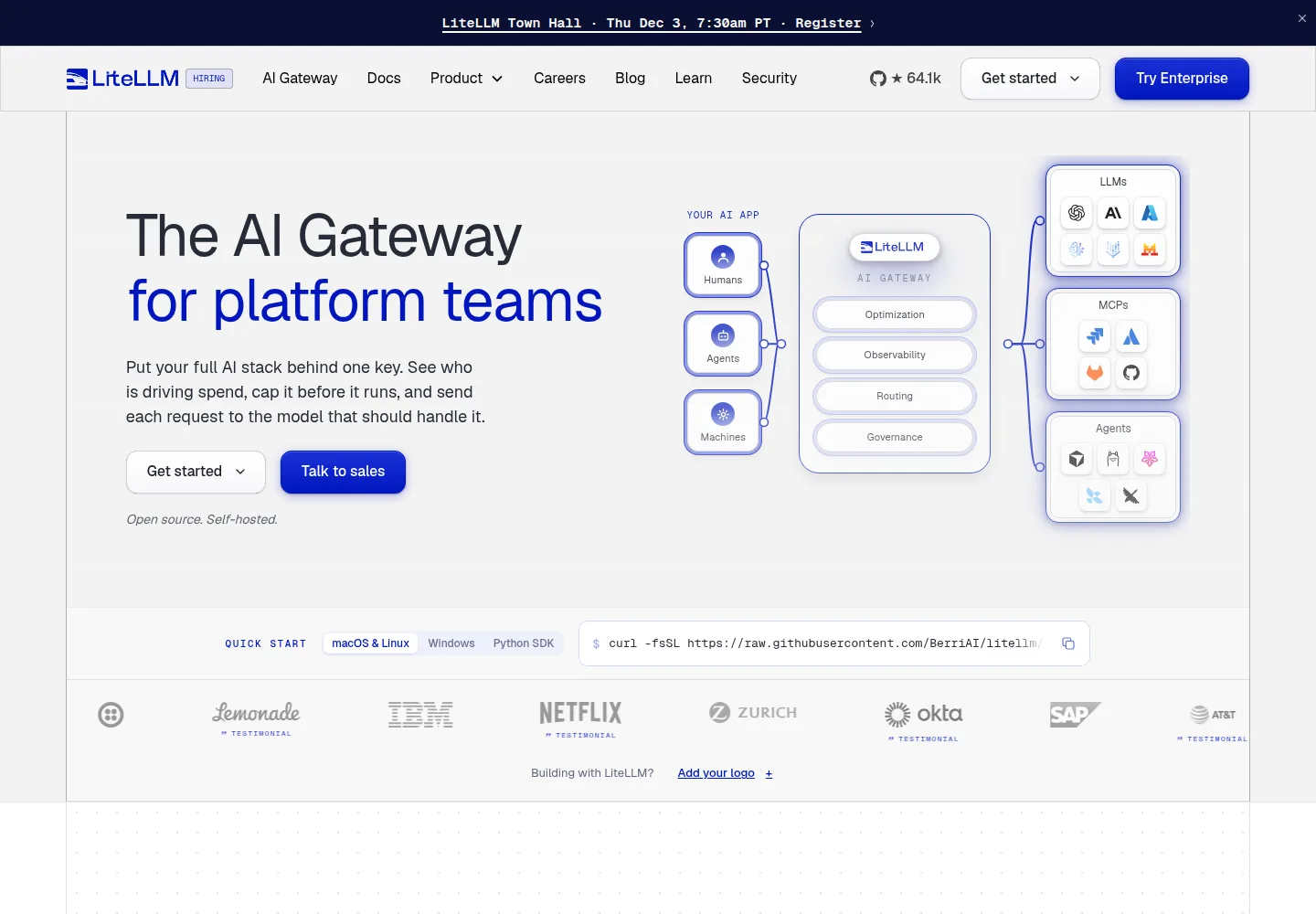
The product behind this listing today is LiteLLM, BerriAI's open-source AI gateway (LLM proxy) — the directory's chatbot classification and tagline predate its current positioning. LiteLLM puts a company's whole AI stack behind one OpenAI-compatible API: 140+ LLM providers and more than 1,800 models (the page also cites 1,892 unique models) become reachable through a single endpoint and a single login, and swapping the model behind an application is a configuration change rather than a code change, with day-zero support for new models and the option to bring internal, fine-tuned and self-hosted models behind the same key. Access is governed through virtual keys scoped by team, project or app, with SSO, hard budgets per key, team, org and model, TPM/RPM rate limits, and spend tracked per key, user, team and tool for chargeback. Guardrails such as PII masking, prompt-injection and secret detection can be attached to traffic, and agents and MCP servers are reached through the same gateway as models. Cost features include load balancing across providers and keys, lowest-cost and automatic routing, response and semantic caching, and prompt compression. The gateway is MIT-licensed and self-hosted — Docker, Helm or Terraform, on your own Postgres and Redis, including fully air-gapped deployments with no telemetry — while an Enterprise tier adds SSO, RBAC, audit logs, SCIM and support on top of the same core.
Editorial guidance based on published documentation. The workflow below is a suggested starting point, not a measured product result.
When to choose Berri.ai
A platform team that needs to give a whole organisation access to many models through one API and one login, without becoming a procurement bottleneck.
An engineering organisation that wants hard budget caps and per-team spend attribution so a runaway job or leaked key cannot quietly run up the bill.
A regulated or privacy-sensitive team that must self-host its model gateway, up to fully air-gapped environments with no telemetry.
When to choose something else
A non-technical user looking for a hosted chatbot builder: LiteLLM is developer infrastructure that you deploy and operate yourself, not a no-code app product.
A team that wants a fully managed SaaS gateway with nothing to run — the open-source core is self-hosted, and the Enterprise tier adds support and governance features rather than a different hosted core.
A single-developer project calling one provider's API directly, where a gateway's keys, budgets and routing add overhead without benefit.
A practical starting workflow
Deploy the gateway in your own stack (Docker, Helm chart or Terraform) on your own Postgres and Redis.
Connect provider keys, ideally through your existing secret manager, and register the models and deployments you want exposed.
Create teams and issue virtual keys scoped by team, project or app, each with its own budget, rate limits and model access.
Point applications at the single OpenAI-compatible endpoint; swap or add models by configuration, without changing app code.
Monitor usage and spend per key, team and model, attach guardrails, and tune routing, fallbacks and caching to control cost.
Check before committing
The directory lists this entry under chatbot with a tagline about creating ChatGPT apps from your own data; the current official site is the LiteLLM gateway, and this entry is written to that current positioning.
Customer quotations on the page — including an AT&T executive's statement that some AI task costs fell by as much as 56% — are testimonials published by the vendor, not independently verified results.
The page's own figures vary by section (140+ providers with 1,800+ models in one place, 1,892 unique models in another), and its Rust-gateway latency and throughput numbers come from the vendor's own published benchmark.
Common questions
What is LiteLLM?
LiteLLM is an open-source AI gateway (LLM proxy) that puts your entire AI stack behind one OpenAI-compatible API. It tracks and caps spend per key, team, and model, routes each request to the right model, and can be self-hosted anywhere, including fully air-gapped.
Yes. The LiteLLM gateway is MIT-licensed and free to self-host. An Enterprise tier adds SSO, RBAC, audit logs, SCIM, and dedicated support on top of the same open-source core — not a different product.
How many LLM providers and models does LiteLLM support?
LiteLLM supports 140+ LLM providers and 1,892 models through one OpenAI-compatible interface, so you can add or swap models without changing application code.
LiteLLM attributes every request automatically and gives each team a virtual key with a hard budget. When a key hits its cap, requests stop, so a runaway job or compromised key cannot quietly run up the bill. Spend can be exported to Prometheus, Datadog, or CloudZero for chargeback.
Kosmoy — Regulated enterprises that need AI inventory, agent governance and gateway policy inside their own Kubernetes.
OrcaRouter — platform teams shipping on many models, since one endpoint routes across providers with upstream 429s absorbed and budgets, roles and audit trails.; security and compliance teams that need policy before spend, since guardrails, PII shielding, agent firewalls and 32 framework packs with exportable evidence are built in.; agent builders who want model choice without lock-in, since teams can bring their own keys or use provider rates with glass-box receipts.
TrustedRouter — TrustedRouter is a privacy-first AI gateway that encrypts all your AI chats and gives access to 680 models confidentially through a single OpenAI-compatible API, starting with one million free tokens and no card required, with provider choice and privacy-minimum routing controls, an attested gateway in a Trusted Execution Environment that fails closed, and bring-your-own-keys support.
Alternatives to Berri.ai
Tools the catalogue itself links to Berri.ai: an editor lists them as related, an editorial comparison or switching guide covers the pair, or both are reviewed picks for the same task. Each reason below can be checked on the tool pages. This is not a quality ranking.
When this listing’s recorded facts changed, from what to what. Dates are the day (UTC) the change was recorded in the ByTask data, not the day the vendor changed anything. Only changes that can be traced in the data history appear here; a fact that has not changed shows nothing.

 Official site reference


