A TypeScript toolkit for building AI agents in JavaScript.
At a glance
Price not confirmed · Source review 2026-10-17
Price & billing
Free, MIT-licensed TypeScript ecosystem as described on the official homepage. No subscription price is published on that page, so no amount is stated here; confirm any managed or enterprise offering separately before budgeting for it.
Published-source facts and editorial guidance. No product test is implied. Confirm current conditions before purchase.
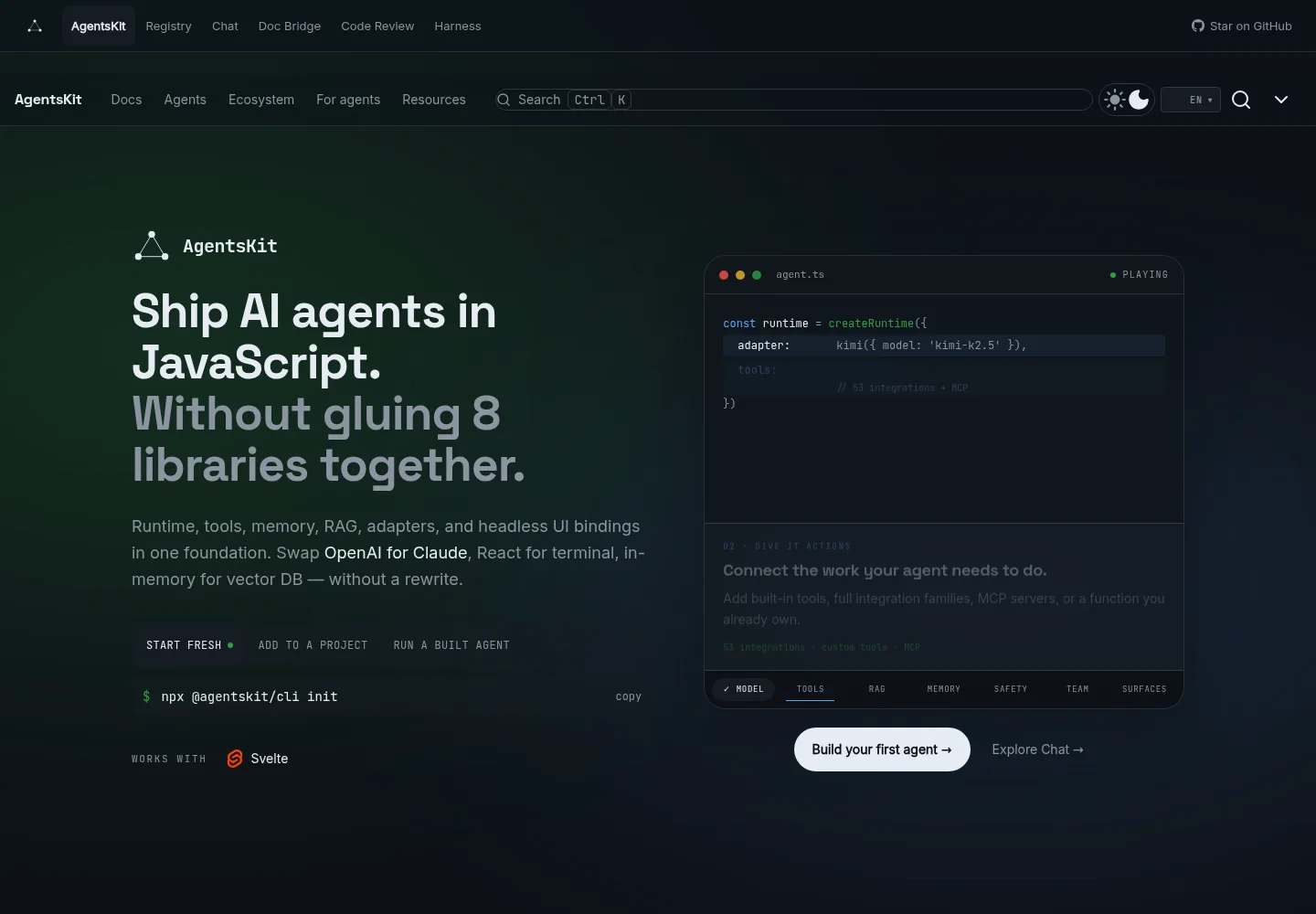
Official website; English-locale capture · Captured 2026-11-29 · Source ↗
This listing has 1 image; no further gallery images exist.
What to know before choosing
Good fit
TypeScript developers building production AI agents they can move between models and infrastructure without a rewrite.
Limits and trade-offs
AgentsKit is a code toolkit and CLI workflow, not a no-code builder or a fully managed hosted platform, so it suits developers comfortable owning code and infrastructure.
Plans and free allowances
Free, MIT-licensed TypeScript ecosystem as described on the official homepage. No subscription price is published on that page, so no amount is stated here; confirm any managed or enterprise offering separately before budgeting for it.
Official-site collection and source-backed editorial review
Dates: Last reviewed 2026-10-31 · Sources checked 2026-10-17. Last reviewed is the latest source or editorial review date; it is not a content-change date.
A closer look at AgentsKit.js
AgentsKit is a free, MIT-licensed TypeScript ecosystem for building production AI agents from composable parts. A tiny, zero-dependency core defines six contracts, and optional packages cover model adapters, runtimes, tools, memory, RAG, observability, sandboxing, and evaluation, plus headless UI bindings. One contract lets you swap models, tools, and infrastructure without a rewrite, and a CLI scaffolds agents, installs ready-made agents from a registry as source you own, and runs them on any provider.
Editorial guidance based on published documentation. The workflow below is a suggested starting point, not a measured product result.
When to choose AgentsKit.js
TypeScript and JavaScript developers who want to build agents without tying an application to one model vendor or one monolithic framework.
Teams that need to swap models, runtimes, or memory backends independently, for example moving from OpenAI to Claude or from in-memory to a vector database.
Developers who prefer owning their agent source code, since registry agents are installed as readable TypeScript into their own project.
When to choose something else
Non-developers looking for a no-code agent builder, since AgentsKit is a code toolkit and CLI workflow.
Developers working outside the JavaScript and TypeScript ecosystem who would need a Python-native equivalent.
Teams that want a fully managed, hosted agent platform with no code or infrastructure of their own.
A practical starting workflow
Install the AgentsKit CLI and scaffold a new agent or install a ready-made agent from the registry as source into your project.
Create a runtime with a model adapter, such as OpenAI, Anthropic, Gemini, or a local model, plus the tools your agent needs.
Add optional layers only where needed, such as memory, RAG, skills, or observability, behind the shared contracts.
Run the agent from Node, a serverless function, an edge runtime, or the terminal, and swap providers later without rewriting the agent.
Check before committing
The homepage describes a free, MIT-licensed ecosystem but does not publish a subscription price, and any managed or enterprise offering would need separate confirmation.
Pricing and feature availability may change; confirm current terms on the official website before committing.
Provider and integration availability can change over time, so confirm that the specific model or integration you need is still supported before building on it.
Common questions
What is AgentsKit?
AgentsKit is a free, MIT-licensed TypeScript ecosystem for production AI agents, with a tiny zero-dependency core, replaceable contracts for models, runtimes, tools, memory, RAG, observability, sandboxing, evaluation, and interfaces, plus headless UI bindings.
Can I change the AI model without rewriting my agent?
Yes, that is the core idea: OpenAI, Anthropic, Gemini, Kimi, local models, or your own adapter use one contract, and the homepage lists 28 native adapters, 222 providers, and 7,870 models behind that contract.
Yes. The registry is described as shadcn-like: one command copies the full agent source into your project, and from there the code is yours to read, edit, and commit.
AgentKey — Developers whose agents need live web, social, market, and crypto data through one key and one balance.
AgentVerse — Developers who want to build, host and discover autonomous agents on the Fetch.ai network
Alma — Olivares AI (listed as Alma) is an open-core, self-hosted platform for governing an enterprise AI estate: the models, agents, MCP servers, identities and data that teams connect. On your own infrastructure you can launch coding sessions, connect resources, set access policies and inspect recorded activity; the site stresses visibility and enforcement depend on the integration and controls configured. The Community edition is the complete product under AGPL-3.0, free for unlimited users with no seat tax. Business adds directories, runtime security and compliance reporting at US$99/month or US$990/year per subscription (not per user, taxes extra); a managed cloud is not planned and has no date. The company is unusually candid about gaps: it is preparing 1.0 as the first stable release, and computed task progress plus the complete operating workflow are explicitly 'not yet verified'. Supported sources include Claude, OpenAI, Gemini, Llama, Ollama/vLLM, Postgres, S3, Vault, Kafka, Kubernetes and AWS/Cloudflare.
Product details from official sources
AgentsKit.js is a TypeScript toolkit for developers building AI agents and chat applications. Its modular packages cover runtimes, model adapters, tools, memory, retrieval, and interface bindings, so projects can use the layers they need. Bindings exist for web, mobile, and terminal frameworks. The UI documentation explicitly warns that shared state and action contracts do not imply identical component APIs across frameworks.
Capabilities and conditions
The toolkit provides a TypeScript foundation for agent runtimes, tools, memory, and retrieval. Source ↗
Its modular packages cover observability, evaluation, and sandboxing alongside agent construction. Source ↗
Framework bindings share core state and actions, but component APIs remain framework-specific. Source ↗
Price and free allowance
Price and free limits not verified. Check the current vendor plans before signing up; this listing does not imply the product is free.
Published-source profile · collected 2026-11-24. Automated collection followed by editorial review. These are vendor-published claims, not hands-on product test results.
Alternatives to AgentsKit.js
Tools the catalogue itself links to AgentsKit.js: an editor lists them as related, an editorial comparison or switching guide covers the pair, or both are reviewed picks for the same task. Each reason below can be checked on the tool pages. This is not a quality ranking.
When this listing’s recorded facts changed, from what to what. Dates are the day (UTC) the change was recorded in the ByTask data, not the day the vendor changed anything. Only changes that can be traced in the data history appear here; a fact that has not changed shows nothing.
Recorded (UTC)
Price & plansPrice and plan wording changed
Review & statusReview level: Imported listing → Reviewed against official sources
Review & statusSources checked: not recorded → 2026-10-17

 Official site reference


